The role of the stromal microenvironment in breast cancer progression
In breast cancer and other solid tumors, the fibrotic extracellular matrix (ECM) is considered prognostic of poor patient outcomes. Increased and aberrant deposition of collagen and other ECM proteins in the breast tumor microenvironment is known to promote metastatic progression and drive mechanisms of therapy resistance. Given the clear role of the ECM in breast cancer, the overarching goal of the Ponik lab research program is to better understand the molecular mechanisms of breast cancer progression due to the pathophysiologic changes in the ECM and to develop therapies that intercept these mechanisms. We integrate cell biology and advanced imaging techniques using 3D cell culture and murine tumor models to investigate three main areas of research: 1) identifying the mechanisms of tumor cell behavior in response to biophysical and biochemical cues from the ECM, 2) defining hormone regulation of the stromal microenvironment, and 3) developing methods to analyze and therapeutically target ECM in the tumor microenvironment.
1. How do tumor cells sense and respond to alteration in ECM structure and composition?
During oncogenic transformation, normal interactions with the ECM are profoundly altered, resulting in cells that lose their polarization and differentiation, lose anchorage dependent growth control, and acquire a migratory, invasive phenotype. To investigate the features of the ECM that are critical to these tumor-associated phenotypes, we use an in vitro 3D collagen gel model. Using this model, we determined that increasing the stiffness of the collagen matrix is sufficient to disrupt breast epithelial differentiation, increase cell proliferation and enhance invasion. However, the specific molecular players and signaling pathways that are regulated by ECM alterations, and how these pathways are involved in the progression of breast cancer is still relatively unknown. Therefore, part of the lab is focused on understanding how cells sense and respond to mechanical and compositional alterations of the extracellular matrix during cell invasion.
2. How does hormone signaling in the stromal microenvironment alter early dissemination and distal metastasis?
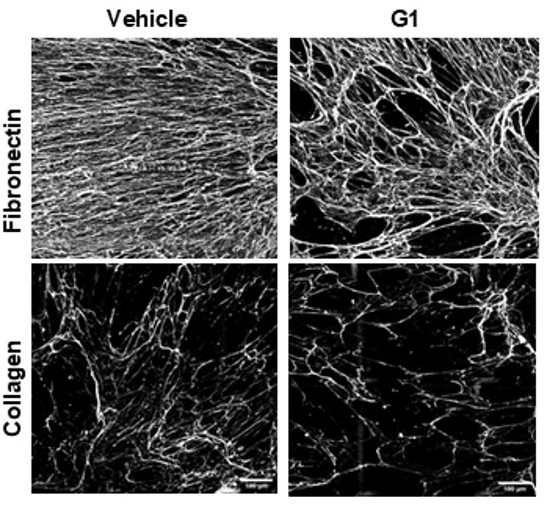
Metastatic estrogen receptor positive (ER+) disease is the primary cause of breast cancer-related deaths. Using an ER+ murine model of mammary cancer, we determined that estrogen action alters ECM composition and collagen organization to promote metastasis to the lung. To further define the mechanisms regulating pathophysiological changes in ECM in the breast tumor microenvironment, my lab is testing the hypothesis that estrogen signaling through the non-canonical, G-protein coupled estrogen receptor (GPER) expressed on fibroblasts results in altered ECM remodeling and tumor suppression. Our continued research in this area will fill a critical gap in understanding estrogen action in the stromal microenvironment of primary and metastatic breast lesions.
3. Can we develop approaches to therapeutically target the ECM in the tumor microenvironment?
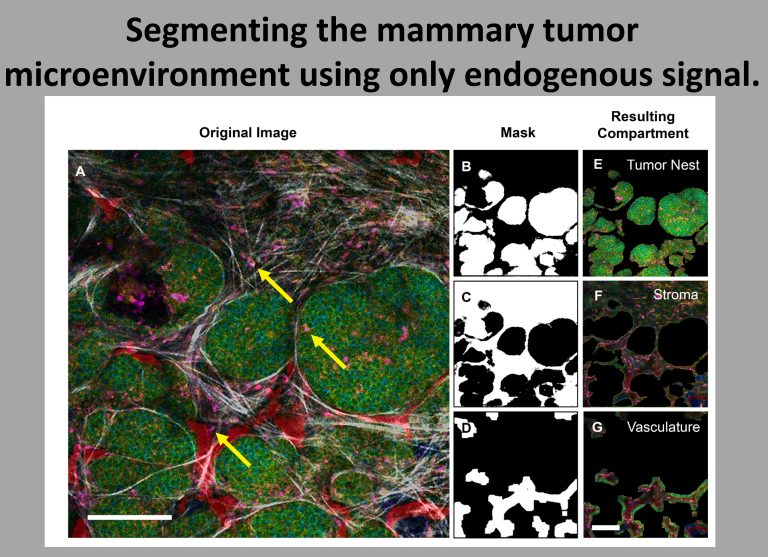
Developing therapies for breast cancer that specifically target the ECM is another major goal of my research program. Our experiments often use intravital imaging to analyze and observe agents that target the tumor microenvironment in live mouse models of breast cancer. However, methods to spatially segment and quantify dynamic interactions between cells and the microenvironment are limited. Using collagen second harmonic generation and endogenous fluorescence from cellular metabolites collected from live murine tumor models, we developed a label-free method to non-invasively segment tumor microenvironment into tumor, stromal, and vascular compartments for in-depth 4D analysis (Burkel et al. 2022).
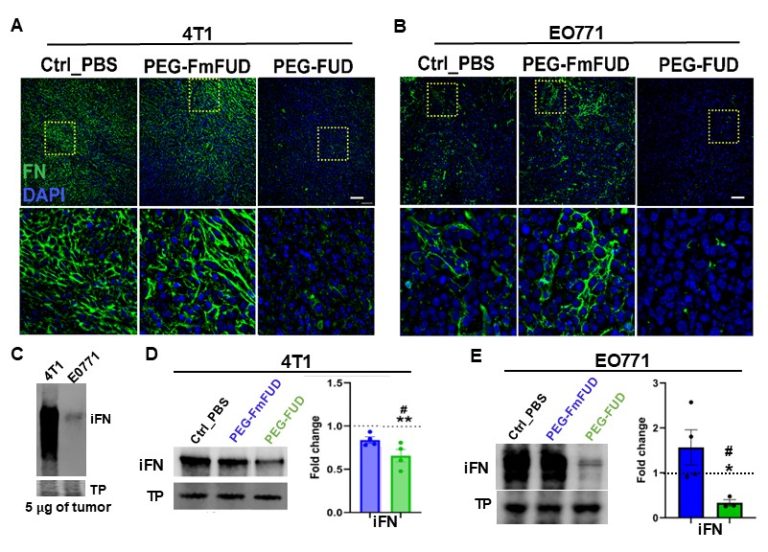
Therapies for solid tumors are challenged by several roadblocks including biophysical barriers to drug penetration and an immune suppressive microenvironment. Notably, the ECM is a key factor that impinges on both of these roadblocks. One approach we are developing to mitigate the ECM roadblock directly targets the ECM protein, FN, with a highly specific peptide (PEG-FUD) that blocks the assembly of FN into a fibrillar matrix. PEG-FUD not only had specificity for primary tumors but also localizes in metastatic lesions in the lungs of tumor-bearing mice. We have recently determined PEG-FUD blocks tumor growth in two models of mammary carcinoma via a reduction of fibrillar FN and increased tumor cell death (Gari et al. 2025). We will continue to work toward the goal of establishing an ECM-targeted approach as a standardized treatment to improve the efficacy of chemo- or immuno-therapies for metastatic breast disease.